Your AI agents don't trust each other.
Every multi-agent system you build today is a liability.
Organisations run agents from different teams, vendors and frameworks. The moment two of them need to work together, there is no shared way to verify who they are, what they're allowed to do, or what they did. SYNTHERA fixes that.
Agents are multiplying. Trust isn't keeping up.
Your company already uses AI agents. Some were built in-house, some came from vendors, some were spun up by teams you've never met. They work fine alone. But the moment one agent needs to call another, or act on another's behalf, four questions have no good answer.
Identity
Which agent is this? Can you verify that claim, or are you just taking its word for it?
Authority
What is this agent actually allowed to do? Where does that permission stop?
Provenance
Who created it? Who approved it? What chain of trust does it carry?
Accountability
What did it do? Is there a record that nobody can quietly edit after the fact?
Right now, every pair of agents that needs to cooperate gets custom glue code.
5 agents means 10 trust relationships. 20 agents means 190.
It doesn't scale, and it can't be audited.
From quadratic glue to a single trust surface
One identity standard every agent speaks.
SYNTHERA gives every agent a VAID (verifiable agent identity). Think of it like a passport. It says who the agent is, what it's allowed to do, and who issued it. Any other agent or system can check that passport instantly, without having to trust the agent's own claim.
Cryptographically signed
Identity is proven, not claimed. Any party can verify a VAID on sight, without trusting the source.
Capability-scoped
The VAID carries exactly what the agent is allowed to do, and nothing more. Permissions travel with identity.
Lineage-tracked
Every VAID records where it came from. Delegation, issuance and chain of trust are traceable end to end.
Identity wrapped in capability, lineage and a verifiable seal
If an agent speaks VAID, you can trust it. Even if you've never seen it before.
One foundation. Five services every agent can rely on.
SYNTHERA is infrastructure, not a library you bolt on. It provides five core services that every agent and every system above it can use: identity, policy, capabilities, audit, and federation. One source of truth for all of them.
Five primitives, one kernel, one source of truth
Identity
Issues, signs and verifies VAIDs. This is where an agent's identity is created and where any party comes to check it.
Policy
A deterministic evaluation engine: sandboxed, repeatable, fast. Rules are authored elsewhere and enforced here.
Capabilities
Authority is granted as bounded, scoped capabilities. An agent can only do what its capability set allows, nothing more.
Audit
A tamper-evident event log. Every action is recorded. No party can quietly rewrite history after the fact.
Federation
Cross-tenant dispatch over a single, well-defined surface. Independent systems coordinate through SYNTHERA, not through each other.
The kernel is canonical. Systems above it subscribe and project from it. They never duplicate its state.
Policy is enforced on the hot path, authored off it. The kernel evaluates; authoring happens elsewhere.
Primitives are consumed, never reimplemented. One identity model, one audit log, one policy engine.
Autoplay — no controls needed; self-advances for a cold visitor. Open presenter mode for walkthroughs →
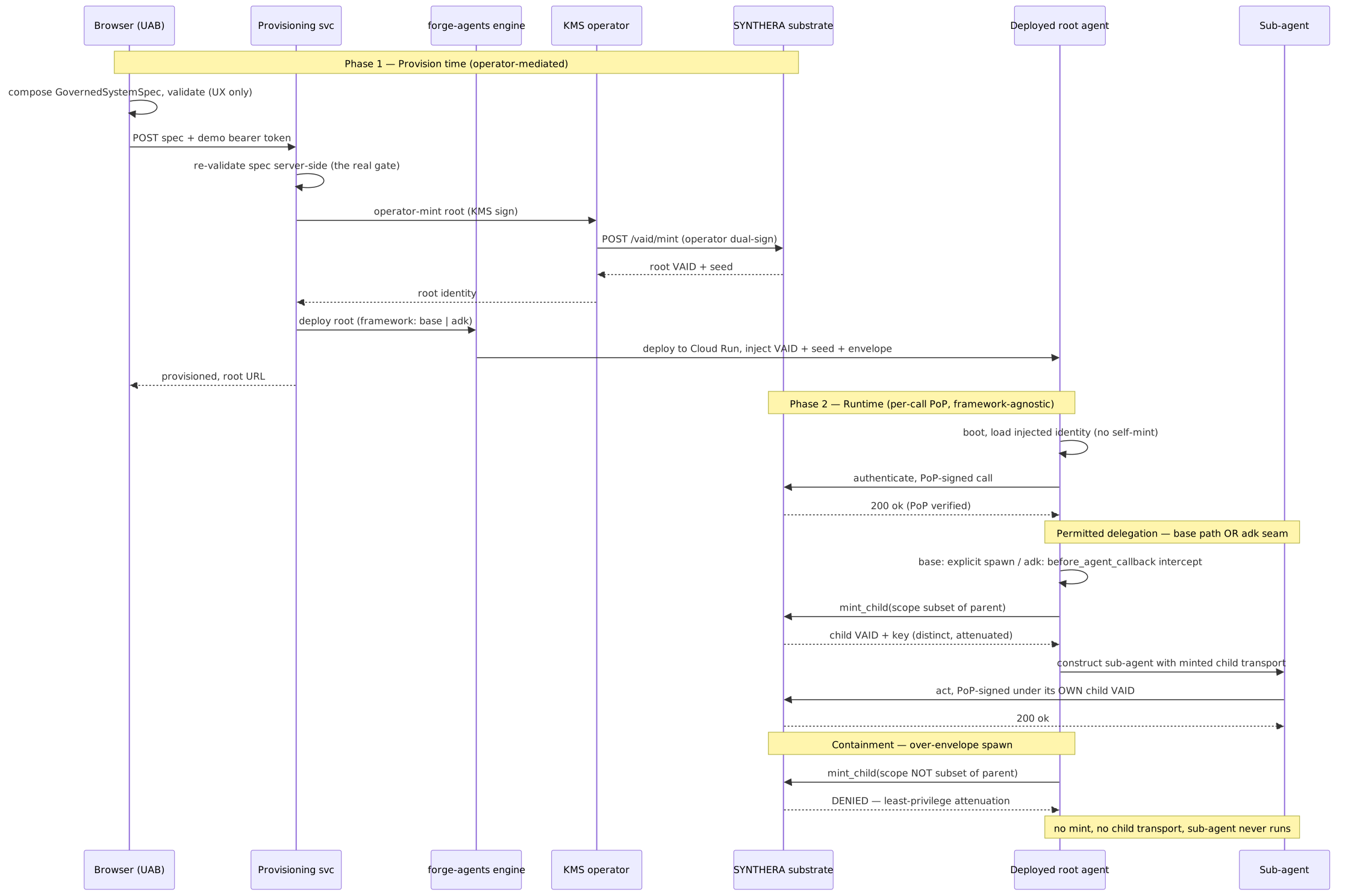
Compose in UAB · provision · mint VAID · delegate at runtime · over-envelope spawn denied at the substrate. Open full-size →
cargo test — the frozen conformance vectors in
vaid-client/tests/ reproduce byte-for-byte. Separately, the
substrate runs live on Cloud Run and governance has been demonstrated
framework-agnostic across ADK, LangChain and OpenAI
adapters; the
captured run exchanges (zip)
illustrate one governed run end to end.
git clone https://github.com/solara-associates/vaid
cd vaid && cargo test
Open vs commercial. VAID — the spec and reference
SDK (vaid-pop, vaid-client) — is open source
(Apache‑2.0). The SYNTHERA substrate (policy, federation, audit,
hosted authority) is the commercial product.
One substrate. Everything else builds on it.
SYNTHERA is the foundation. The names around it are not five competing products to choose between — they are layers of a single stack. You compose at the top; the substrate governs all the way down to the identity primitive underneath.
Compose a governed multi-agent system. The public product builders work in.
Generates and runs governed systems — a Prime Builder and a Loyal Opposition review each other, with a human as the final gate.
The trust & coordination substrate. Governs throughout: identity, policy, capabilities, audit, federation — one source of truth for everything above it.
The identity primitive underneath. A verifiable agent identity — the unit everything else is built from, like a container image for trust.
Compose at the top · governed all the way down to the primitive
Every layer speaks VAID, evaluates against the same policy, and writes to the same audit log. That shared foundation is what lets them compose without custom integration — the proof the architecture works.
Containers followed a pattern. This is following the same one.
Direction, not commitment. Three phases worth thinking about.
The primitive
Docker took a messy idea (how to ship software) and turned it into a standard unit anyone could verify. SYNTHERA does that for agent identity: a working kernel, a verifiable envelope, proven against the systems already built on it.
The orchestration layer
Once containers existed, an orchestration layer grew around them. Kubernetes coordinated what Docker made portable. The same shape is emerging here. UAB, AI Factory and Sentinel are independent layers that compose because the primitive underneath is stable.
Open governance
Kubernetes eventually moved to neutral stewardship under CNCF, so no single vendor owned the standard. SYNTHERA is built with the same handover in mind. A trust layer no one party controls.
The governance and licensing model is an open decision. What's fixed is the destination: a trust layer the whole ecosystem can rely on because no one party owns it.
Early access is open to a small group of organisations.
SYNTHERA is for teams putting agents into production who already feel the cost of making them work together safely. If that's you, we'd like to talk.